
8 Ways to Find Shopify Stores That Actually Work in 2026
Eight free ways to find Shopify stores by niche, country, launch date and sales signals, each one checked by hand in November 2026 and tied to a tool you can open next.
SalesTracker research team16 min read
To find Shopify stores, search Google with site:myshopify.com plus a niche word, browse a Shopify store directory by category, then confirm traffic before you study a store.
Most guides to finding Shopify stores stop at a list of search tricks. That gets you domains, and then you are left guessing which of them are worth your time. This guide covers both halves of the job: eight methods that turn up Shopify stores, and the checks that tell you whether a store you found is busy, new, local to your market or quietly selling well.
Every method below was run by hand on November 7, 2026. Where a number appears, it comes from the SalesTracker traffic leaderboard or from the public files every Shopify store serves, and the source sits next to it.
How Do You Find Shopify Stores? The Short Answer
You find Shopify stores by searching Google for pages on the myshopify.com domain, browsing a Shopify store directory by niche, and checking any store you find for traffic before you study it.
| Method | What it finds | Time | Cost |
|---|---|---|---|
| 1. Google search operators | Stores that mention your keyword | 5 to 15 min | Free |
| 2. Niche directories | The busiest stores in an industry | 2 min | Free |
| 3. New store boards | Recently launched stores gaining visitors | 2 min | Free |
| 4. meta.json country check | Where a store is based and ships to | 1 min per store | Free |
| 5. Dropshipping signals | Stores likely running a dropshipping model | 5 min per store | Free |
| 6. Best-seller URL | A store's own best-selling order | 1 min per store | Free |
| 7. Traffic and sales checks | Whether a store actually sells | 2 min per store | Free to start |
| 8. Store search by name | The exact store behind a brand name | 1 min | Free with sign-in |
Shopify does not publish a public list of the stores it hosts, so every method works from the outside. Some methods start with a search engine, some start with a directory that already sorts stores, and some start with a single store and read the public files Shopify serves for it. The table above lines them up by what each one finds and how long it takes.
If you only have ten minutes, use two methods together. Search Google for your niche on myshopify.com to collect names, then open each name in the Shopify traffic checker to see which ones get real visitors. That pairing removes most of the dead and abandoned stores that plain searching turns up.
If you need a longer list, start from a directory instead. The SalesTracker category directories group stores by industry and sort them by estimated monthly visits, so the busy stores come first and you skip the long tail of shops nobody visits. One small catch: looking up a store by name on SalesTracker asks you to sign in with Google first, which takes a few seconds.
1. How to Find a Shopify Store With Google Search
You find a Shopify store with Google Search by adding site:myshopify.com to a product or niche keyword, which limits results to pages on the domain every Shopify store is given.
Two Google queries we ran on 2026-11-07, and what the first page returned
site:myshopify.com "dog harness"
  6 different harness stores, among them Ruffwear, Wild One
  and Walkabout Harnesses

"powered by shopify" "linen dresses"
  8 linen dress collections, almost all small independent shops
Every Shopify store gets a free address that ends in myshopify.com when it is created, and Google still indexes pages on those addresses after a store connects its own domain. When we ran site:myshopify.com "dog harness", the first page held six different harness stores, from Ruffwear to small single-brand shops, even though most of them sell on a custom .com today.
The second operator that works is a phrase from the default Shopify footer. Searching "powered by shopify" "linen dresses" finds stores that left the footer credit in place. Many established brands remove it, so the query tends to surface smaller shops: our run returned eight linen dress collections, almost all from independent stores, which is useful when you want shops at your own stage.
Google results are a starting list, not a verdict. Expect a mix of live stores, closed stores and test shops. Run each domain through the Shopify store detector if you are unsure it still runs on Shopify, and through the traffic checker before you spend time on its products. Google documents the site: operator in its search operator guide.
Check before you study. Google results mix live stores with closed and test shops. Paste any domain into the Shopify store detector to confirm it still runs on Shopify, then check its traffic.
2. How to Find Shopify Stores in Your Niche
You find Shopify stores in your niche fastest with a directory that groups stores by industry and sorts them by traffic, so the busiest stores in that niche appear first.
Stores by industry, SalesTracker traffic leaderboard, May 2026
- Lifestyle (fashion, beauty, jewelry)221
- Sports42
- Electronics and tech39
- Food and drink39
- Health38
- Home and garden36
- Arts and entertainment28
Search operators find stores that use a word. Directories find stores that belong to a category, which is closer to what most people mean by a niche. SalesTracker keeps six category directories, for fashion, beauty, home, electronics, food and health, each ranked by estimated monthly visits.
The chart above shows how the stores on the May 2026 SalesTracker traffic leaderboard spread across industries. Lifestyle brands, which include fashion, beauty and jewelry, make up 221 of the 572 stores. Sports, electronics, food and health follow far behind. If your niche sits in one of the smaller groups, the directory gives you a short list quickly and you can read every store on it.
For a niche the directories do not cover, combine methods. Use a Google query with your product words, then open the stores you find in the traffic checker and sort them yourself. When you want design ideas rather than a ranking, our Shopify store examples page picks stores by niche and explains what each one does well.
A directory also helps you size a niche before you commit to it. If your industry shows dozens of stores above 100,000 estimated monthly visits, there is proven demand, and a newcomer will need a sharp angle to stand out. If only a few stores clear 20,000 visits, demand may be thin or the niche may be early, and the trending board shows which of the two it is.
3. How to Find New Shopify Stores
You find new Shopify stores by watching boards that rank recently launched or fast-growing stores, because new stores rarely show up on lists sorted by total traffic.
When leaderboard stores registered their domains
- Before 200585
- 2005 to 200968
- 2010 to 201298
- 2013 to 2015215
- 2016 to 201873
- 2019 to 202213
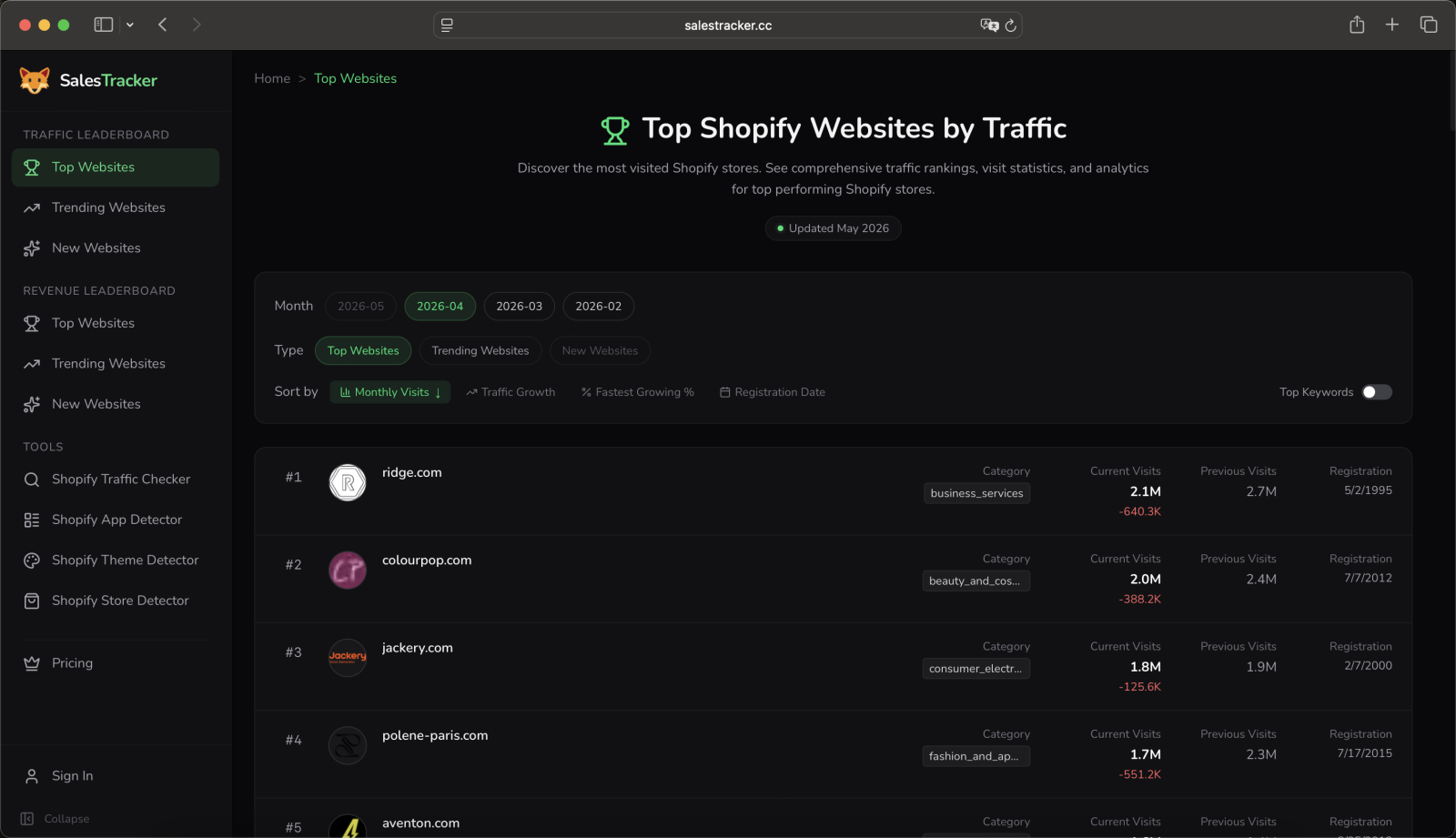
Big traffic lists are dominated by stores that have been around for years. Of the 552 stores on the May 2026 SalesTracker traffic leaderboard with a known domain registration date, only 13 registered their domain in 2019 or later, and 215 registered between 2013 and 2015. A new store has to grow for a long time before it competes on total visits.
That is why the new Shopify stores leaderboard and the trending stores leaderboard exist. The first ranks recently launched stores that already draw measurable traffic. The second ranks stores by month-over-month growth, which surfaces younger brands that are breaking out before they reach the top of the main list.
Two quick checks help you confirm a store is new. A WHOIS lookup shows when the domain was registered, and the copyright year in the store footer often shows when the shop went live. A domain from the last two years with growing traffic is the profile most people mean when they search for a list of new Shopify stores.
Check a store you just found
See estimated monthly visits, traffic sources and global rank for any Shopify store, free.
Check store traffic4. How to Find Shopify Stores in the USA
You find Shopify stores in the USA by opening a store's public /meta.json file, which states the country the store is registered in, its currency and how many countries it ships to.
ruffwear.com/meta.json, fields shortened, read 2026-11-07
{
  "name": "Ruffwear",
  "city": "Bend",
  "province": "Oregon",
  "country": "US",
  "currency": "USD",
  "myshopify_domain": "ruffwear.myshopify.com",
  "published_products_count": 143
}
Every Shopify storefront serves a small public file at /meta.json. Add it to any store address, for example ruffwear.com/meta.json, and you get the store name, city, state, country code, currency and the number of published products. It is the quickest way to answer whether a store is American, and it works on stores that hide their address everywhere else.
We read that file for the stores on the May 2026 SalesTracker traffic leaderboard and got an answer from 322 of them. 232 of those 322 stores, or 72 percent, are registered in the United States, and 78 of the American stores sit in California, far ahead of New York and Texas with 23 and 22. The UK came second overall with 26 stores, then Australia with 12 and India with 11.
To build a list of Shopify stores in the USA from scratch, set Google to the US region, run the search operators from method 1 with a US word such as a state name, and confirm each result with /meta.json. Currency alone is not enough: 15 of the non-US stores in our sample also price in US dollars.
Where leaderboard stores are based
- United States232
- United Kingdom26
- Australia12
- India11
- Canada8
- Hong Kong8
- Other countries25
5. How to Find Shopify Dropshipping Stores
You find Shopify dropshipping stores by looking for a cluster of signals, such as long shipping windows, a small generic catalog and a young domain, because Shopify never labels a store as dropshipping.
1Shipping window
Policy pages that quote 7 to 20 business days, or a warehouse abroad.
2Catalog shape
A small, loosely related catalog.
/meta.jsonshows the published product count.3Domain age
A domain registered in the last one or two years, visible in any WHOIS lookup.
4Traffic pattern
Sharp jumps month to month, which often follow ad pushes. Check it in the traffic checker.
No public field says a store dropships. Shopify does not tag stores by business model, and no directory can filter for it precisely, ours included. What you can do is read the signals a dropshipping store usually leaves, then decide store by store. The four checks above cover most cases in a few minutes.
Shipping policy is the strongest single signal. A store that quotes 7 to 20 business days to the US, or ships from a warehouse in another country, is often fulfilling through a supplier. A catalog of a few dozen loosely related products with generic names points the same way, as does a domain registered in the last year or two.
Once you have a few candidates, check whether they get traffic before you copy anything. The top Shopify dropshipping stores page lists fast-growing stores worth studying, and the dropshipping sales tracker shows how to read a store's estimated sales once you have picked one.
Keep notes as you go. A simple sheet with the domain, shipping window, product count, domain age and estimated monthly visits for each candidate turns a pile of browser tabs into a comparison you can act on. After ten or so stores, the pattern in your niche is usually easy to see.
No store is labeled dropshipping. Shopify does not tag stores by business model, so every dropshipping list, ours included, is built from signals. Judge each store on its shipping policy, catalog and traffic.
6. How to Find a Shopify Store's Best Sellers
You find a Shopify store's best sellers by adding /collections/all?sort_by=best-selling to its address, which lists the whole catalog in the store's own best-selling order.
- 1
Open the store
Start from the home page of the store you found.
- 2
Add the path
Append /collections/all?sort_by=best-selling to the domain.
- 3
Read the order
The first rows are the products the store sells most of.
- 4
Get the numbers
Open the store on SalesTracker for estimated units and revenue.
Shopify collections support a built-in sort called best-selling, and the all collection holds every published product. Put the two together and the storefront shows its products ranked by the store's own sales order. It works on most Shopify stores, needs no tool, and takes about a minute.
Two limits are worth knowing. Some stores turn off the all collection or redirect it, and the sort shows order, not quantity, so you see which products lead without seeing how many units they sold. Treat it as a ranking of what the store sells most of, not a sales figure.
When you need numbers behind the order, the SalesTracker sales snapshot estimates units sold and revenue for a 24-hour sample day and names the best-selling products and variants. Traffic and catalog size are free there, and revealing the sales figures uses a few credits per store.
Run the same check on three or four competitors and line up their first rows. A product that leads on several stores at once is a proven seller in your niche. A product that leads on only one store is more often that brand's own signature item than a trend you can follow.
7. How Do I Find Shopify Stores That Actually Sell?
You find Shopify stores that actually sell by checking traffic first, then growth, then an estimate of sales, because a store without visitors cannot be selling much.
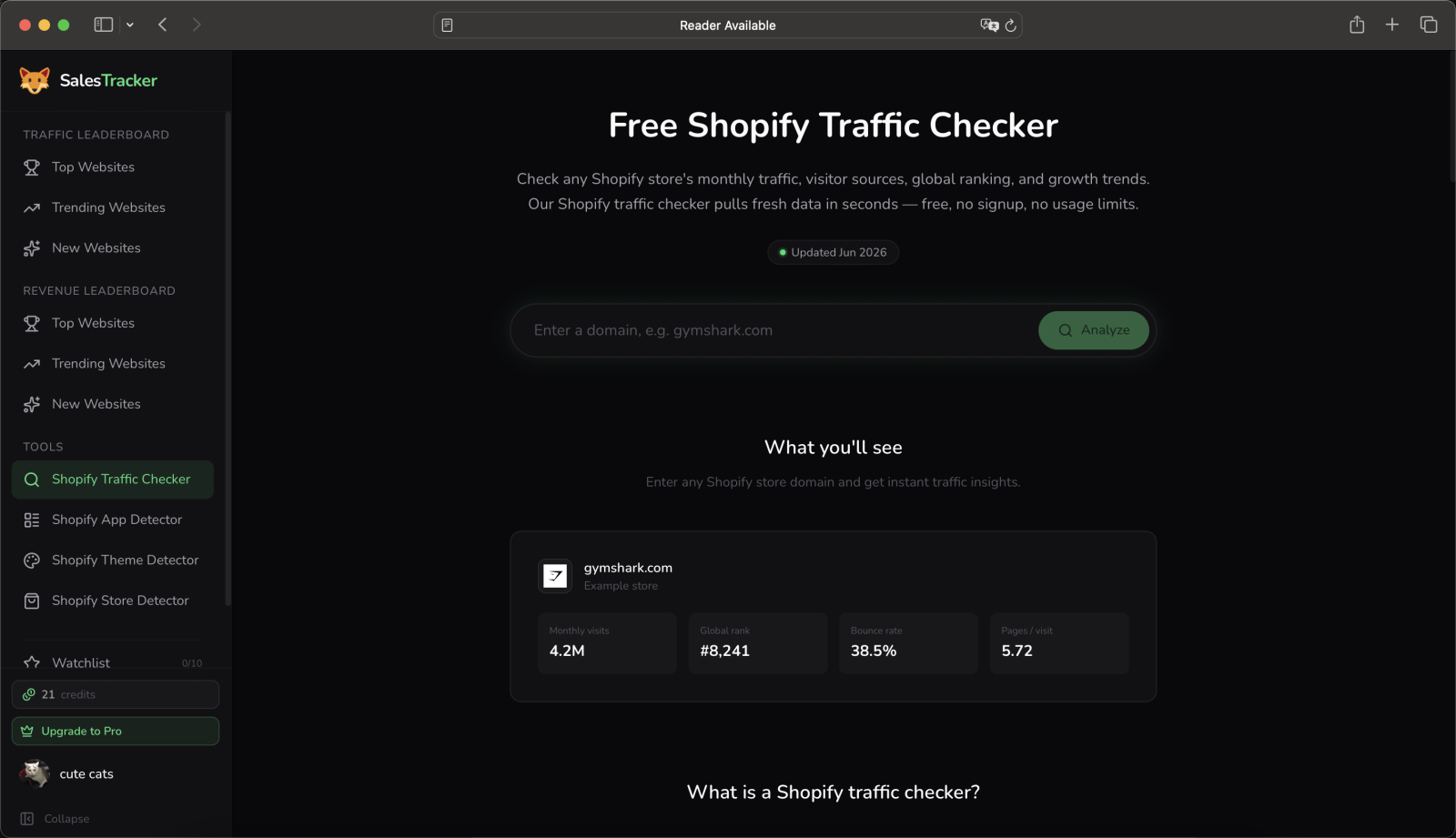
Finding stores is easy. Finding the ones worth studying is the real work. Traffic is the cheapest filter: a store with a few hundred visits a month is either new or stalled, while one with hundreds of thousands has a working way to bring people in. The Shopify traffic checker shows estimated monthly visits, traffic sources and global rank for any store, free.
Growth is the second filter. On the May 2026 SalesTracker traffic leaderboard the median store drew about 78,800 estimated monthly visits and grew 4.7 percent on the month before, and 328 of the 572 stores grew at all. A store well above that pace is worth a closer look, and the trending leaderboard sorts by that growth for you.
Sales estimates come last, once a store has passed the first two checks. The Shopify revenue checker and the sales snapshot estimate what a store sells in a 24-hour sample day, drawn from multiple public data sources. Estimates carry a margin of error, so compare stores with each other rather than reading any single number as exact.
8. How to Find a Shopify Store by Name or URL
You find a Shopify store by name by searching the brand on SalesTracker or Google, then reading the store's myshopify.com domain from its /meta.json file to confirm it is the right shop.
Brand names collide. Three stores can share a name in different countries, and resellers often borrow a brand name for a lookalike shop. Searching the name on SalesTracker returns the store profile with its domain, traffic and catalog, and the search is free with a Google sign-in.
To confirm a store's identity, read its permanent Shopify address. Every store keeps a myshopify.com domain that never changes, even when the brand switches its custom domain. You will find it in the myshopify_domain field of /meta.json. Two sites with the same myshopify domain are the same store.
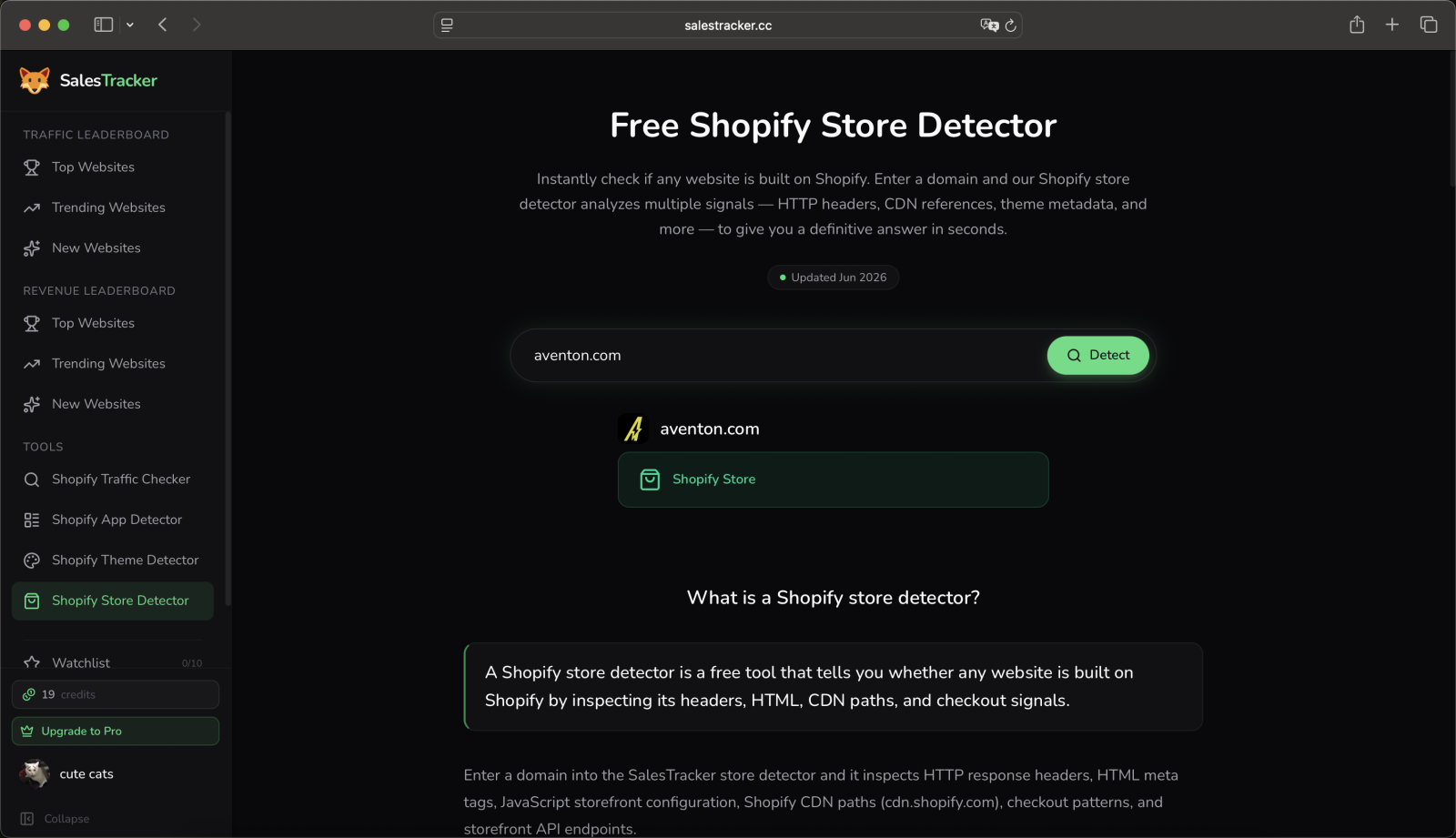
If you only have a URL and want to know whether it is a Shopify store at all, the Shopify store detector answers in seconds, and our guide on how to tell if a website is Shopify walks through the manual checks.
Country domains can mislead too. One brand may run separate stores on .com, .co.uk and .com.au, each with its own catalog and prices. Read the store name and the myshopify domain in each site's /meta.json together before you decide whether you are looking at one business or several.
Find the Shopify stores worth studying
Browse stores by niche, sorted by estimated monthly visits, then open any store for its traffic and catalog.
Browse Shopify stores by nicheHow We Checked Each Method
Each method in this guide was run by hand on November 7, 2026, against real stores, and the numbers come from the SalesTracker traffic leaderboard and public Shopify files.
For the search methods we ran the two queries shown in method 1 on Google, US region, and read the first page of results. For the file methods we requested /meta.json from the stores on the May 2026 leaderboard, kept the 322 that answered, and opened the best-selling collection URL on Aquarium Co-Op, where it put the store's flagship fertilizer first while a title sort put a java fern first.
Store counts, industries and registration years come from the May 2026 month file of the SalesTracker traffic leaderboard, which covers 572 stores. Traffic figures are estimates built from multiple public data sources, and the leaderboard updates monthly, so the live pages may show newer numbers than this guide.
We rank our own tools where they fit the job and say so. Where another approach is better, such as a WHOIS lookup for domain age or a paid database for a full export of every store, we point you there.
How to Find Shopify Stores FAQ
Is there a list of all Shopify stores?
No public list of every Shopify store exists, because Shopify does not publish one. Paid databases such as Store Leads and BuiltWith sell large exports built by crawling the web. For research, a ranked directory is usually more useful: the SalesTracker directories and leaderboards list the busiest stores by niche, free, sorted by estimated monthly visits.
How do I find other Shopify stores like mine?
Start from your own category. Open the matching SalesTracker category directory, then search Google with site:myshopify.com and the two or three words that describe your best product. Stores that show up in both places are your closest peers. Check their traffic so you compare yourself with stores at a similar size, not only the giants.
How can I find out how much a Shopify store makes?
Shopify does not publish store sales, so every number you see online is an estimate. The Shopify revenue checker estimates what a store sells in a 24-hour sample day, drawn from multiple public data sources, with a typical margin of error of 10 to 15 percent. Use it to compare stores with each other rather than as an exact figure.
How do I find out who owns a Shopify store?
Read the store itself first. The About page, the footer and the contact or legal pages usually name the company. The public /meta.json file gives the city and state the store is registered in. A WHOIS lookup on the domain sometimes adds a registrant, although many owners use privacy protection. For a business contact, the company name plus LinkedIn usually finds the right person.
How do I find a store on Shopify by its name?
Search the brand name on SalesTracker, which returns the store profile with its domain, traffic and catalog after a free Google sign-in. On Google, search the name with the word Shopify or with site:myshopify.com. Confirm you have the right store by matching its myshopify.com domain in /meta.json, since several stores can share one brand name.
What are the top Shopify stores in the USA?
The largest US Shopify stores by traffic include established brands in fashion, beauty and outdoor gear. The top Shopify stores page ranks the busiest stores by estimated monthly visits and updates every month. To keep only American stores, check each one with /meta.json, which shows the country code, or use method 4 in this guide.
Can I search for Shopify stores on Google for free?
Yes. Google search operators are free and need no account. Combine site:myshopify.com with a product word, or search the phrase "powered by shopify" with your niche in quotes. Results include closed and test stores, so confirm each domain with the free Shopify store detector and a traffic check before you study it closely.
How do I find Shopify stores on Reddit?
Store owners post their shops for feedback on r/shopify and r/dropship, often in threads titled store review or rate my store. Search those subreddits with your niche word. Posts link straight to young stores, which makes Reddit a good source of early-stage examples. Check traffic before you treat any posted store as a success story.
Sources and References
First-party figures come from the SalesTracker traffic leaderboard. Shopify file formats were read directly from live stores on 2026-11-07.
- SalesTracker traffic leaderboard, May 2026 month file, 572 stores, estimated monthly visits
- Google Search Central: site: search operator, how the site: operator limits results
- Shopify Help Center: collections, collection sort orders, including best selling
- ruffwear.com/meta.json, example of the public store file, read 2026-11-07